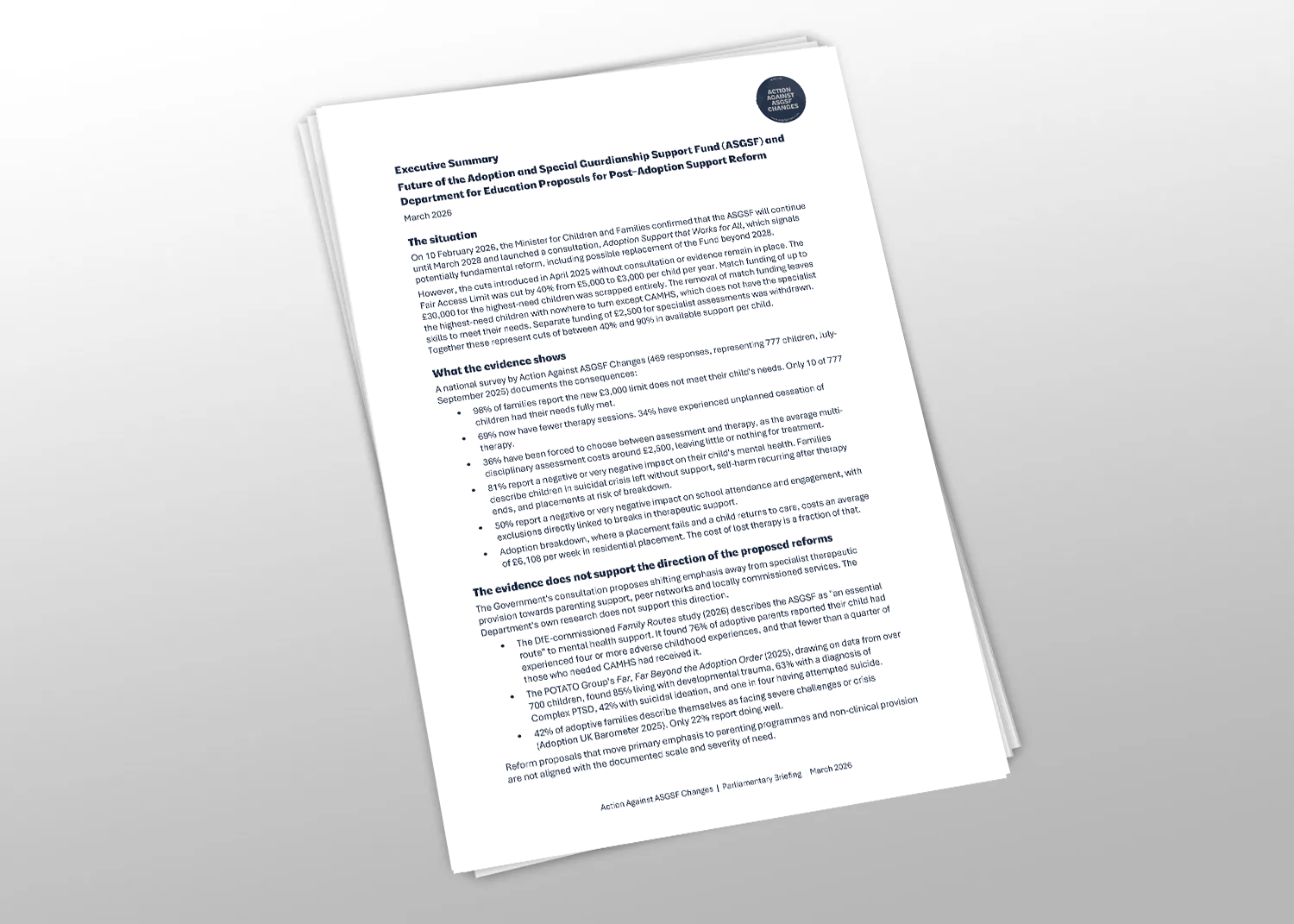
Click here to download the Action Against ASGSF Changes parliamentary briefing, March 2026
Executive Summary
Future of the Adoption and Special Guardianship Support Fund (ASGSF) and Department for Education Proposals for Post-Adoption Support Reform
March 2026
The situation
On 10 February 2026, the Minister for Children and Families confirmed that the ASGSF will continue until March 2028 and launched a consultation, Adoption Support that Works for All, which signals potentially fundamental reform, including possible replacement of the Fund beyond 2028.
However, the cuts introduced in April 2025 without consultation or evidence remain in place. The Fair Access Limit was cut by 40% from £5,000 to £3,000 per child per year. Match funding of up to £30,000 for the highest-need children was scrapped entirely. The removal of match funding leaves the highest-need children with nowhere to turn except CAMHS, which does not have the specialist skills to meet their needs. Separate funding of £2,500 for specialist assessments was withdrawn. Together these represent cuts of between 40% and 90% in available support per child.
What the evidence shows
A national survey by Action Against ASGSF Changes (469 responses, representing 777 children, July-September 2025) documents the consequences:
- 98% of families report the new £3,000 limit does not meet their child’s needs. Only 10 of 777 children had their needs fully met.
- 69% now have fewer therapy sessions. 34% have experienced unplanned cessation of therapy.
- 36% have been forced to choose between assessment and therapy, as the average multi-disciplinary assessment costs around £2,500, leaving little or nothing for treatment.
- 81% report a negative or very negative impact on their child’s mental health. Families describe children in suicidal crisis left without support, self-harm recurring after therapy ends, and placements at risk of breakdown.
- 50% report a negative or very negative impact on school attendance and engagement, with exclusions directly linked to breaks in therapeutic support.
- Adoption breakdown, where a placement fails and a child returns to care, costs an average of £6,108 per week in residential placement. The cost of lost therapy is a fraction of that.
The evidence does not support the direction of the proposed reforms
The Government’s consultation proposes shifting emphasis away from specialist therapeutic provision towards parenting support, peer networks and locally commissioned services. The Department’s own research does not support this direction.
- The DfE-commissioned Family Routes study (2026) describes the ASGSF as “an essential route” to mental health support. It found 76% of adoptive parents reported their child had experienced four or more adverse childhood experiences, and that fewer than a quarter of those who needed CAMHS had received it.
- The POTATO Group’s Far, Far Beyond the Adoption Order (2025), drawing on data from over 700 children, found 85% living with developmental trauma, 63% with a diagnosis of Complex PTSD, 42% with suicidal ideation, and one in four having attempted suicide.
- 42% of adoptive families describe themselves as facing severe challenges or crisis (Adoption UK Barometer 2025). Only 22% report doing well.
Reform proposals that move primary emphasis to parenting programmes and non-clinical provision are not aligned with the documented scale and severity of need.
The consultation is excluding the children it most affects
The children and young people’s survey asks respondents to use abstract reasoning about funding systems, reform proposals and future consequences. This cohort is disproportionately affected by ADHD, FASD, autism, developmental trauma and impaired executive functioning. Research by Gilbert et al. (2023) found significantly greater vulnerability to positively framed and leading questions among adolescents with FASD. The survey’s format, length and framing are not designed with these young people in mind.
The consequence is systematic participation bias. The young people least able to engage with a survey of this kind are precisely those with the most complex needs, the highest dependence on specialist therapeutic support, and therefore the greatest stake in the outcome. Their voices are the most important and the least likely to be heard.
The adults’ survey has similar limitations. Many families come to specialist support following acute crises involving self-harm, suicidal ideation or child-to-parent violence. An online survey without trauma-informed scaffolding or explicit reassurance around data security and confidentiality is unlikely to feel psychologically safe for disclosing these experiences. The most severe and complex cases risk being systematically under-represented.
There is no published analytical methodology, no commitment to independent oversight, and no clarity on what weight responses will carry relative to fiscal constraints or pre-existing policy direction.
What we are asking MPs to do
- Press for immediate reversal of the April 2025 cuts and restoration of the Fair Access Limit to at least £5,000 per child.
- Seek reinstatement of match funding and separate assessment funding.
- Request publication of modelling and evaluation evidence underpinning the reform proposals.
- Seek guarantees that any future model will be ring-fenced and nationally consistent to prevent a postcode lottery.
- Call for full transparency on how consultation responses will be analysed and weighted, including how the Department will account for systematic participation bias among the most vulnerable young people.
- Ask the Government what steps it has taken to ensure children with neurodevelopmental difference, FASD, developmental trauma and executive functioning difficulties can participate in the consultation on equal terms, and what additional methods it will use to capture their views.
- Call on the Government to pause the consultation until the design of both surveys has been independently reviewed, concerns about participation bias have been addressed, and accessible alternatives have been put in place to ensure that children with neurodevelopmental conditions, developmental trauma and executive functioning difficulties can engage on equal terms.
About this briefing
This summary is produced by Action Against ASGSF Changes, a campaign of adoptive and kinship care families supported by leading adoption charities and therapeutic providers. A full parliamentary briefing with detailed evidence, references and suggested parliamentary questions follows.
Full Briefing
Future of the Adoption and Special Guardianship Support Fund (ASGSF) and Department for Education Proposals for Post-Adoption Support Reform
March 2026
1. Overview
On 10 February 2026, the Minister for Children and Families, Josh MacAlister MP, made a Written Statement to Parliament confirming that the Adoption and Special Guardianship Support Fund (ASGSF) will continue until March 2028. He also launched a public consultation, Adoption Support that Works for All, which signals significant reform of post-adoption and kinship support, including potential structural changes to, or replacement of, the ASGSF beyond 2028.
While confirmation of continuation provides short-term stability, the cuts introduced in April 2025 remain in place and are causing ongoing harm:
- The Fair Access Limit was reduced by 40%, from £5,000 to £3,000 per child per year.
- Match funding of up to £30,000 per child per year for those with the greatest need was removed entirely. The removal of match funding leaves the highest-need children with nowhere to turn. In practice, many will be referred to CAMHS. Yet CAMHS does not possess the specialist skills required to meet the needs of this cohort.
- Separate funding of £2,500 for specialist assessments was withdrawn.
These represent 40–90% cuts in the per-child limits available under the previous Government. Evidence from families and providers demonstrates that these changes have already reduced therapeutic hours, interrupted treatment plans, triggered safeguarding referrals, and destabilised elements of the specialist provider market.
Adoption and kinship care are also among the most cost-effective interventions available to Government. Kinship care saves approximately £4.3 billion per year; adoption saves approximately £4.2 billion. Adoption generates an estimated value of at least £1.3 million per child adopted over a lifetime. Reducing the therapeutic support that sustains these placements is economically short-sighted as well as harmful.
This briefing draws on evidence from our Parent/Carer Survey (469 respondents representing 777 children), The POTATO Group’s open letter to the Minister, published research, and DfE-commissioned reports. It summarises key concerns and identifies areas for parliamentary scrutiny.
2. Evidenced Impact of the 2025 Cuts
2a. The £3,000 Fair Access Limit is not sufficient
The Government stated that the reduction would allow more families to access therapy. Survey evidence (469 responses representing 777 children, collected July-September 2025. https://asgsfprotest.com/pcsurveyapril2025/ ) shows the opposite:
- 98% of families report that the new £3,000 Fair Access Limit does not meet their child’s needs.
- Of 777 children represented in the survey, only 10 had their needs fully met by the new limit.
- By contrast, 42% of respondents reported the previous £5,000 limit as sufficient.
- 69% now have a reduced number of therapy sessions.
- 34% have experienced unplanned cessation of therapy.
- 55% have had to wait longer for support.
- Anecdotally, therapy providers tell us they have not seen an increase in the number of families accessing support since the cuts.
| “The reduced funding limit has ripped away the consistent help my child was finally starting to trust. We’ve had to cut therapy short, space sessions too far apart, and go without the specialist input that was helping them feel safe and understood. Now, progress has stalled, old behaviours have crept back, and their anxiety has increased.” Parent respondent, survey 2025 |
2b. Assessment or therapy: an impossible choice
The removal of separate assessment funding has created a cruel dilemma. A specialist multi-disciplinary assessment costs on average £2,500. With the Fair Access Limit now set at £3,000, families can no longer fund both assessment and therapy within the same annual allocation.
- 36% of survey respondents have been forced to choose between assessment and therapy.
- 23% report that therapy recommended following assessment is now unavailable due to cost.
- 18% have been unable to access assessment at all.
| “Can’t get any support because we need a full Neurodevelopmental assessment to know what therapy is required but we can’t get one due to funding cuts. Child no longer attends school due to their needs but we can’t get any help.” Parent respondent, survey 2025 |
2c. Impact on children’s mental health and safety
81% of respondents report a very negative or negative impact on their child’s mental health since the cuts. 85% report a very negative or negative impact on emotional wellbeing. Families described acute crises directly linked to the withdrawal of therapy:
- Children in active suicidal crisis left without support.
- Self-harm recurring after therapy was stopped or shortened.
- 88% of parents and carers report a very negative or negative impact on their own mental health.
| “When your child has serious suicidal ideations and their therapy is vital to their wellbeing, to have it reduced, interrupted and stopped is criminal. Who will be responsible for the damage that is occurring to all these vulnerable young people?” Parent respondent, survey 2025 |
2d. Impact on school attendance and placement stability
50% of children in the survey have experienced a negative or very negative impact on school engagement and attendance. Families reported exclusions, moves to SEMH schools, and deteriorating behaviour directly following breaks in therapy. Separately:
- 75% of respondents report a very negative or negative impact on family relationships.
- 70% report a very negative or negative impact on stability at home.
- Multiple respondents describe placements at risk of breakdown. Adoption breakdown, where a child returns to local authority care, costs an average of £6,108 per week in residential placement – many times the cost of therapeutic intervention.
Key questions for parliamentary scrutiny:
- What assessment has the Department made of the impact of the April 2025 changes on child safety, school attendance and placement stability?
- What evidence does the Department hold demonstrating that the £3,000 Fair Access Limit is sufficient to meet complex clinical need?
- Will the Secretary of State commit to restoring the Fair Access Limit to at least its pre-April 2025 level, and to reinstating separate assessment funding and match funding?
3. Scale and Clinical Complexity of Need
A substantial body of research, including the Department’s own commissioned work, demonstrates that adopted and kinship children experience elevated rates of trauma and complex mental health need. The Government’s consultation frames most needs as addressable through non-clinical provision. The evidence does not support this framing.
- The DfE-commissioned Family Routes study (January 2026) found that 76% of adoptive parents reported their young person had experienced four or more adverse childhood experiences. Nearly half reported a need for CAMHS in the previous year, yet fewer than a quarter had received support. Families described high thresholds, repeated referral failures, and support only becoming available once difficulties reached crisis point.
- Adoption UK Barometer 2025: 42% of families describe themselves as facing severe challenges or crisis; only 22% report being “mostly doing well”.
- The APPG for Adoption and Permanence Adoptee Voices Inquiry Report (2026): 92% of adoptees believe specialist help is needed to understand their past; 51% wanted mental health support but could not find help that worked.
- The DfE-commissioned Beyond the Adoption Order (Selwyn et al., 2014) concluded that post-adoption support must be central to permanence planning and identified adolescence as a period requiring sustained, specialist, multidisciplinary intervention.
- The POTATO Group’s research, Far, Far Beyond the Adoption Order (2025), drawing on data from over 700 children, found: 85% living with developmental trauma; 63% with a diagnosis of Complex PTSD; 93% experiencing anxiety; 59% with reported self-harm; 42% with suicidal ideation; one in four having attempted suicide. Neurodevelopmental conditions were widespread, with ADHD reported in up to 65% and FASD diagnosed or suspected in nearly two-fifths.
The Family Routes study describes the ASGSF as “an essential route” to mental health support. Yet the consultation document asserts that most children’s needs can be met through non-clinical services, suggesting that needs have been “medicalised”. This is not a finding supported by the Department’s own commissioned research.
Key questions for parliamentary scrutiny:
- On what evidential basis does the Department conclude that most needs can be met through non-clinical provision, given the prevalence data in its own commissioned research?
- What assessment has the Department made of the ability of CAMHS and other statutory services to absorb the clinical complexity documented across this cohort?
4. Direction of Reform: Risks to Specialist Provision
The consultation signals a structural shift: from a nationally administered specialist fund towards locally determined support offers, with expansion of Adoption England pilot schemes and increased emphasis on parenting support, peer networks and early help. These concerns regarding that direction are set out in The POTATO Group’s open letter to the Minister (February 2026). https://www.thepotatogroup.org.uk/post/open-letter-asgsf-consultation
4a. Misalignment with the evidence base
The POTATO Group has raised specific concern about the proposed model for key life-stage transitions. The consultation references providing proactive support at secondary school transition. Discussions with DfE officials indicate that the proposed model may consist of six two-hour online therapeutic parenting sessions.
If that is correct, the model understates the complexity of what transition involves for this cohort. Secondary school transition for young people with developmental trauma involves a convergence of puberty, environmental change, heightened threat perception, identity formation and, for many, escalation of previously managed difficulties.
The evidence base does not characterise adolescent transition as a brief parenting skills issue. Beyond the Adoption Order (Selwyn et al., 2014) identified adolescence as a period of heightened instability requiring specialist, multidisciplinary intervention.
4b. Absent safeguards in proposed structural reform
- The Government proposes scaling up Adoption England pilot schemes as a basis for national reform, but those pilots are still running. There is not yet sufficient evidence from them to justify their expansion into a replacement for a nationally guaranteed funding model by 2028.There is no clear commitment to ring-fenced funding in any future model.
- There is no published modelling of the impact of devolved commissioning on access, consistency or specialist capacity.
- There is no clarity on how narrowly defined evidence hierarchies may exclude relational, multi-modal and trauma-informed therapies that are not easily amenable to randomised controlled trial design.
Absent ring-fencing, devolved commissioning risks postcode variation and the erosion of guaranteed specialist access. The specialist provider capacity, built over more than a decade, is already showing signs of contraction. Some providers have ceased trading or withdrawn from ASGSF-funded work. This capacity, once lost, cannot easily be rebuilt.
Key questions for parliamentary scrutiny:
- Will future funding remain ring-fenced? If not, what mechanism will prevent a postcode lottery?
- What published evaluation underpins the expansion of Adoption England pilot schemes?
- What modelling has been undertaken on the impact of devolved commissioning on specialist capacity and access?
- How will the Department ensure that evidence frameworks reflect the complexity of developmental trauma, rather than privileging interventions most amenable to traditional trial design?
5. Consultation Design and Transparency
The consultation covers potentially fundamental reform, including possible termination or restructuring of the ASGSF in 2028. The POTATO Group has set out detailed concerns about the robustness of the consultation process in its published open letter to the Minister.
5a. Survey design and participation bias
The consultation survey compresses significant structural reform proposals into agreement scales with limited contextual framing. Many proposals are expressed in inherently positive terms, such as ensuring money is “used wisely” or giving families a “strong start”, which makes them difficult to disagree with at face value and may not support meaningful critical engagement.
The children and young people’s survey raises particular accessibility concerns. Adopted and kinship young people are disproportionately affected by ADHD, autism, FASD, impaired executive functioning and trauma-related hypervigilance. The survey requires sustained abstract reasoning about systems, funding and future consequences, which represents a significant cognitive demand for this cohort. Research by Gilbert et al. (2023) found significantly greater vulnerability to leading and positively framed questions among adolescents with FASD. The survey does not include explicit trauma-informed scaffolding, reassurance around data security or confidentiality, or guidance for young people with executive functioning difficulties.
This introduces systematic participation bias. The most complex and vulnerable young people, those with the greatest stake in the outcome, may be least likely to complete or meaningfully engage with the survey.
Given these concerns, we are calling on the Government to pause the consultation until the design of both surveys has been independently reviewed, trauma-informed scaffolding has been built into both, the analytical methodology has been published, and adequate safeguards are in place to ensure that families and young people with the most complex needs are not systematically excluded from a process that will determine the future of the support they depend on.
5b. Decision-making transparency
The consultation document provides no description of analytical methodology, no commitment to publishing full quantitative data, and no explanation of how qualitative evidence will be synthesised or weighted. It does not identify who will conduct the analysis, nor whether those responsible will have expertise in developmental trauma, neurodevelopmental conditions, adoption or kinship care. There is no commitment to independent oversight, and no clarity on whether individuals with lived experience will be involved in interpreting the findings.
Critically, the document does not state what weight consultation responses will carry relative to fiscal constraints or pre-existing policy direction. In the absence of this transparency, stakeholders cannot assess whether the consultation is genuinely open to shaping policy or is validating a predetermined direction.
Key questions for parliamentary scrutiny:
- Who will analyse consultation responses, and what expertise will inform interpretation? Will individuals with lived experience be involved?
- Will full quantitative and qualitative data be published?
- What weight will survey responses carry relative to financial constraints and pre-existing policy direction?
- What steps have been taken to ensure the consultation format does not exclude those least able to engage, particularly young people with executive functioning difficulties, neurodevelopmental difference or trauma-related disengagement?
- How will the Government ensure compliance with the Public Sector Equality Duty in the design and interpretation of the consultation?
6. Recommendations for Parliamentary Scrutiny
MPs may wish to:
- Press for immediate reversal of the April 2025 cuts to the Fair Access Limit, with restoration to at least the pre-April 2025 level of £5,000 per child.
- Seek reinstatement of match funding for children with the greatest need, and separate ring-fenced funding for specialist assessments.
- Request publication of the modelling and evaluation evidence underpinning reform proposals, including the Adoption England pilot schemes.
- Seek guarantees that any future funding model will be ring-fenced and nationally consistent, with clear mechanisms to prevent postcode variation.
- Call on the Government to pause the consultation until the design of both surveys has been independently reviewed, concerns about participation bias have been addressed, and accessible alternatives have been put in place to ensure that children with neurodevelopmental conditions, developmental trauma and executive functioning difficulties can engage on equal terms.
- Request full transparency regarding consultation analysis: who will conduct it, what expertise will inform it, what methodology will be used, and whether full data will be published.
- Call on the Government to ensure that any future evidence framework reflects the complexity of developmental trauma, rather than excluding therapies not amenable to narrow hierarchies of clinical trial evidence.
Conclusion
Adopted and kinship children are disproportionately affected by early trauma, neurodevelopmental conditions and complex mental health needs. The ASGSF has provided, for over a decade, the only guaranteed national route to specialist therapeutic support for this cohort. The Government’s own commissioned research, including the Family Routes study, describes it as an essential route to that support.
The 2025 funding reductions were introduced without consultation, without an evidence base, and in direct conflict with the Labour manifesto commitment to support children in care. They have already caused measurable harm: interrupted treatment, escalating crises, school exclusions, and placements at risk of breakdown. The costs of those breakdowns, in human and financial terms, will far exceed the savings.
While continuation until 2028 is welcome, the current consultation signals potentially fundamental reform without published evidence that alternative structures will meet documented levels of need. Parliamentary scrutiny is essential to ensure that reform is evidence-led, transparent, and aligned with the Government’s own research.
About Action Against ASGSF Changes
Action Against ASGSF Changes is a campaign of adoptive and kinship care families, supported by leading adoption charities and therapeutic support agencies. Our Parent/Carer Survey (October 2025) drew on 469 responses representing 777 children and young people across England.
Contact: [email protected] | www.asgsfprotest.com
Campaign supporters:
Adoption Matters, Adoption UK, Beacon House, The Belay Foundation, Blossoming Minds, Body & Soul, BUSS Model, Consortium of Adoption Agencies, Consortium of Voluntary Adoption Agencies, Chrysalis Associates, The Child Psychology Service, Coram, Creating Adoption Networks, Daddy & Dadda, DDP Connects UK, DDPI, Eden House Wellbeing, Equipt Therapy Services, Eden House Wellbeing, Family Futures, The Family Place, Gateway Psychology, Institute of Recovery from Childhood Trauma, It Takes a Village, Kinship, Nurture Psychology, PAC-UK, PATCH, The Potato Group, PsyCAF, Psychology Associates, Sensory Smart Child Therapies, Terapia, Theraplay, Touchbase, We Are Family, Whole Step, Your Space Therapies.